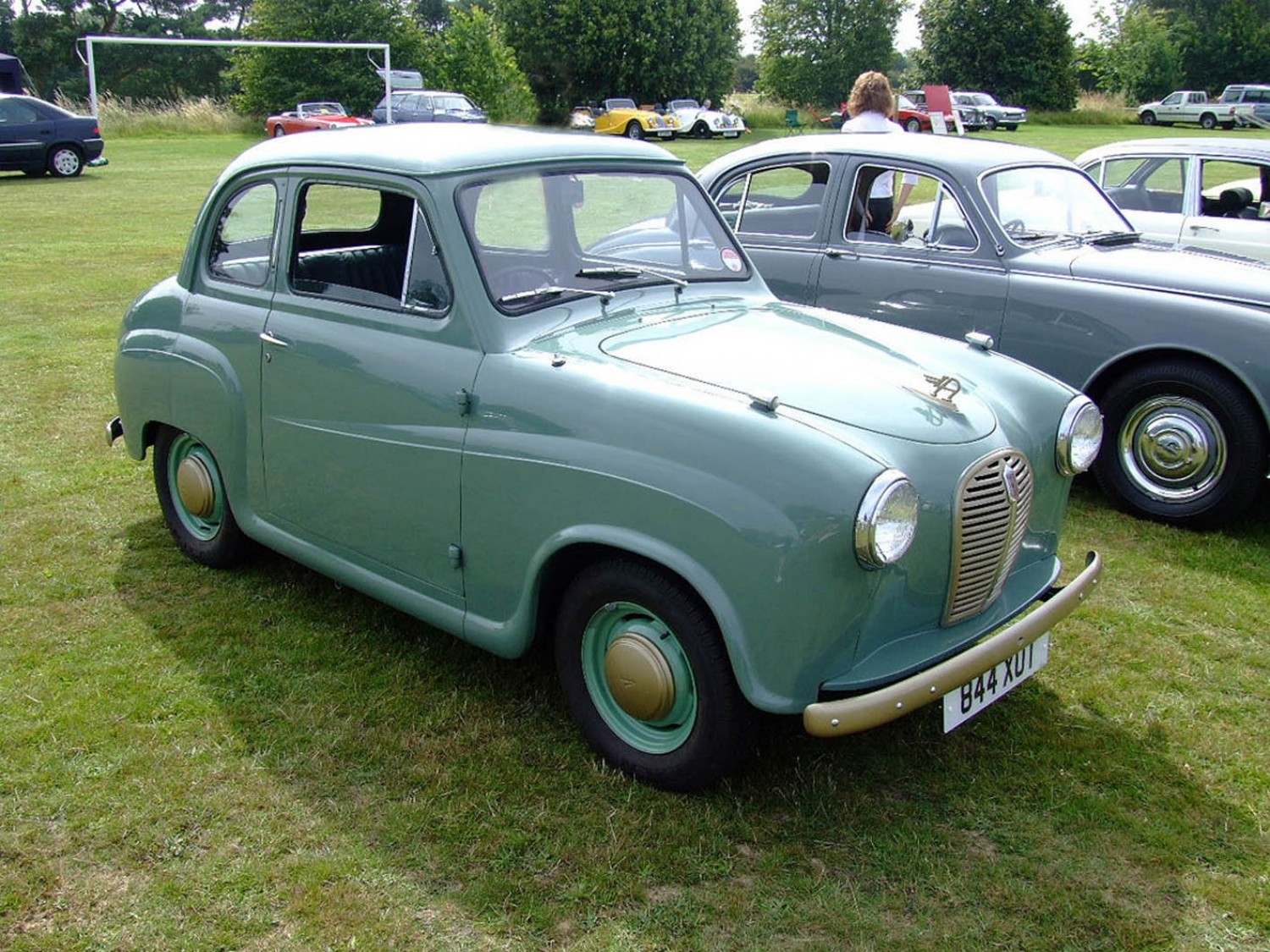
AUSTIN always had an eye to the budget end of the market, with massive sales of its pre-war Seven, but as Britain cruised to a new age of motoring in the 1950s something needed to be done to retain the small car laurels.
The answer was the A30, a natural successor to the Seven but which did not appear until 1951.
Morris had been off to a flying start after the war and whipped the wraps off the Minor in 1948, gaining impressive sales.
Austin had some catching up to do with the A30 which had a curvy Anglo-American style which was like a stripped down and scaled down A70 Hereford.
But its tall, narrow body caught on and a deciding factor with many was the fact that at £507 it was cheaper than the Morris Minor by £62 - a tidy sum in those days.
The body was of fully stressed monocoque construction, the first Austin to be made in this way, which made it both lighter and stiffer than most contemporary vehicles.
It may have looked a bit toylike and was indeed spartan inside, but the truth is that the little A30 was an advanced car for its day.
It was rather cosy inside and four could fit at a pinch, but in those days cheap motoring meant going without a lot of the things we now take for granted.
For instance the there was only a single windscreen wiper and sun visor in front of the driver. If you wanted a passenger side wiper and sun visor, and a heater you had to pay extra.
The A30 and its later development the A35 came in a variety of bodystyles including four-door saloon, two-door saloon, a van a countryman estate and the rare pick-up.
The van was a great success, although of smaller loading capacity than the Morris Minor van.
It offered the same payload and because it was lighter and stiffer it found favour with operators because of its toughness and long life.
An interesting feature of the day was the trafficator, an illuminated arm which popped out of the side of the car when indicating a turn. I remember you really had to watch out for them as they were quite small and usually dim.
The robust design had proved itself over the years with many still on the road in the hands of a devoted band of fans..
Under the bonnet was the newly designed A-Series 803cc four-cylinder petrol engine which was state of the art in the 1950s and meant that with a fair tailwind this little car could wind itself up to the dizzy heights of 70mph.
However, cornering at high speed in the A30 in its standard form could produce some startling circus tricks, especially on loose surfaces.
An early magazine road test managed nearly 68mph and a yawn-inducing 0-60mph 'sprint' of 42.3 seconds.
I drove an early version many years ago and made a mental note that if you wanted this car to achieve its maximum speed, you needed a calendar not a stopwatch.
This was in many ways to do with the octane rating of fuel in those days.
In the Second World War branded fuel disappeared and the nationally available standard fuel available at the beginning of 1952 had an octane rating of just 70, which meant relatively low compression ratios.
This of course hammered performance but as 1953 neared branded fuel was back and compression ratios were progressively improved along with the performance figures of cars such as the Austin A30 and the later A35.
The design had a long life and won many friends. The saloon died in 1959 but the estate lived on until 1962 and the van proved its worth in an impressive way by carrying on until 1968.