GROWINGcar dimensions over the past 20 years have created a parking crisis for millions of motorists, new analysis has revealed.
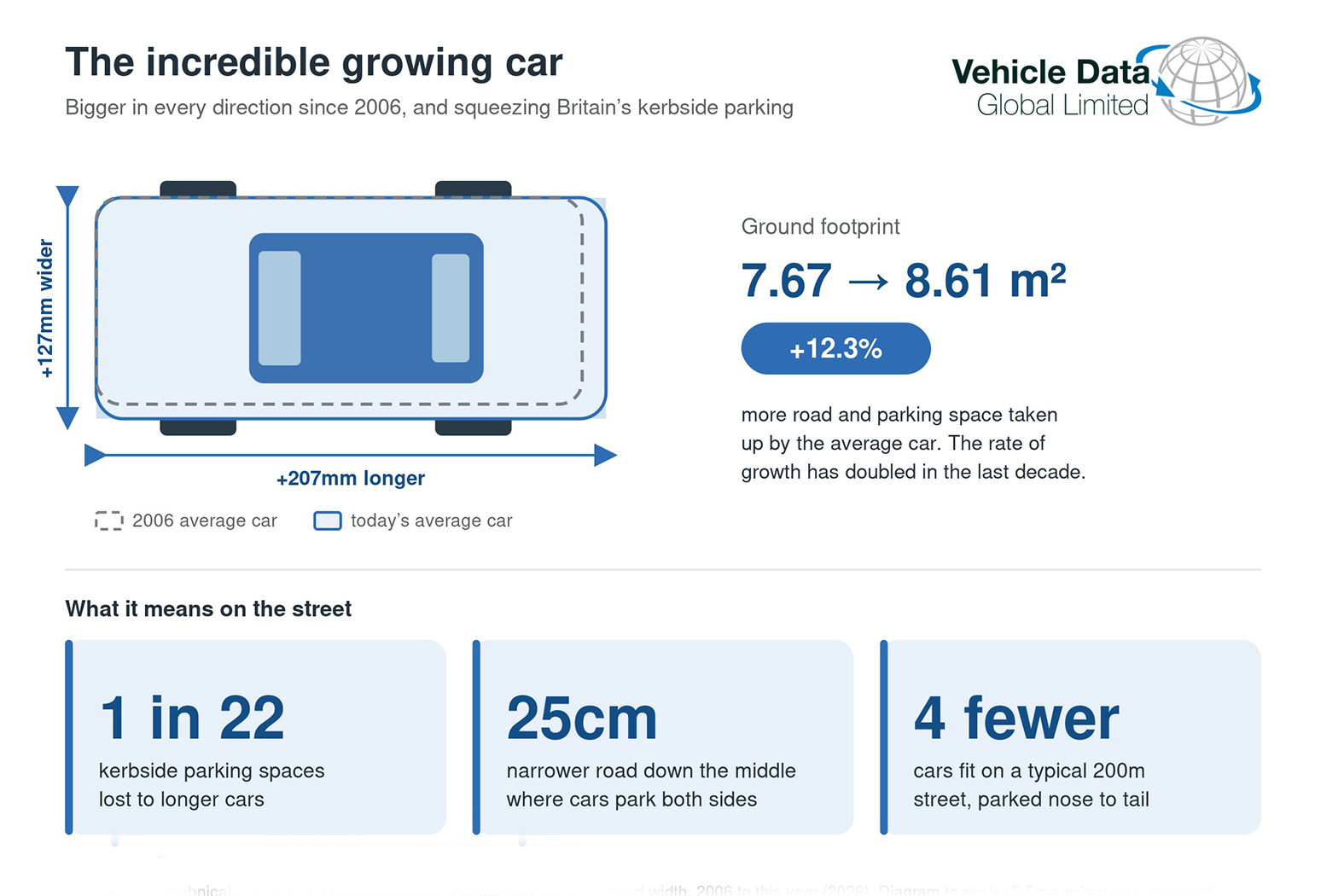
The average car now occupies almost one square metremore space, meaning that a 200-metre residential street provides kerbside parking for four fewer cars.
Analysis by automotive data technology specialist, Vehicle Data Global (VDG), reveals that the average car this year has a footprint of 8.61 square metres, compared with 7.67squaremetres in 2006.
VDG says that the rate of increase in car sizes doubled over the past decade, compared to the period of 2006 to 2016, so that the problem of parking is worsening more rapidly.
The car growth phenomenon is not only due to the growing popularity of larger SUV body styles over the period measured.
For example, the popular small Vauxhall Corsa now occupies 7.17 square metres, compared with 6.01squaremetres in 1995 - an increase of 19.3 per cent.
The medium-size Ford Focus grew from 7.07 square metresin 1998 to 8.02 square metresfor the recent final model - an increase of 13.4 per cent.
And the Volkswagen Golf increased by 12.4 per cent since 1995 - from 6.81 square metresto 7.66 square metres
With 32 per cent of households in England having no off-street parking, the problem is especially acute in residential areas, where VDG calculates that one in 22 kerbside spaces have been lost due to the average increase in car lengths.
Meanwhile, for streets with parking on both sides, the drivable area has been significantly reduced.
For a typical 5.5 metre residential street, the drivable channel has narrowed from about 1.89 metres in 2006 to 1.64metres.
The resulting inconvenience for drivers is illustrated by the example of a typical residential terraced street of 200 metres, with parking on both sides. In 2006 the street could accommodate 94 cars, parked nose to tail - but that number has shrunk to 90. Allowing a more realistic half-metre between vehicles to pull in and out, the street could take around 84 cars in 2006, but only about 81 today, leaving three or four without a space.
The rate of size increase doubled in the past 10 years alone, resulting in the average car this year occupying 0.64 square metres more space than in 2016 and 0.94 metres more since 2006.
That's growth in the space occupied by the average car of 12.3 per cent over 20 years.
With an additional 5.7 million cars registered in Britain, compared with 2006, the scale of 'parking pain' is unprecedented, says VDG.
VDG maintains the definitive current and historical technical database of car features for automotive businesses, including car dimensions. The analysis was based on 43.9 million registrations and excludes vans, which have grown even more than cars over the period.
The average van today is 5.3 metres long, compared with 4.9 metres in 2006, with an overall footprint of 11.3 square metres, creating even more headaches for on-street parking.
While cars have consistently grown in size and number over the past 20 years, parking provision has not kept pace. This has led many homeowners with cars to pave over front gardens, with the RAC Foundation estimating in 2012 that 7 million homes now had parking areas instead of front lawns.
Data on other car parking spaces is variable, with no evidence of significant increases, while planning policy has been designed to discourage car use in recent decades. For example, the number of spaces available for new housing was deliberately capped so that provision reduced even as car ownership increased by 20.5 per cent.
VDG's analysis helps to shed light on why incidents of 'parking rage' are so often reported in the media, as motorists struggle to find space for their increasingly large cars. And why last year, the online property platform Rightmove found that 71 per cent of users are irritated by neighbours' parking, while the AA has reported that 16 per cent of motorists have argued with other drivers over parking. The AA also found that 60 per cent of drivers see parking outside their house as a basic right.
Ben Hermer, operations director of VDG, said: "While the sheer volume of cars on the road, compared with a few decades ago, tends to dominate media stories about parking problems, our analysis shows the inevitability of even greater parking pain due to the steady increase in vehicle dimensions.
"With the average car taking up more space than ever before, many drivers without off-street parking are increasingly squeezed out of the spaces they would have had 20 years ago.
"It shows that the increase in interior space and comfort that we all enjoy in modern cars has come at a significant cost in stress for millions of drivers."




.jpg)