DECLININGfuel efficiency has increased British motorists' exposure to global conflict, new analysis from Vehicle Data Global has revealed.
Fuel economy already worsened over the past decade, with British cars now thirstier than ever before, but the Ukraine war and then the Iran conflict starkly revealed the cost of motorists' preference for ever bigger cars.
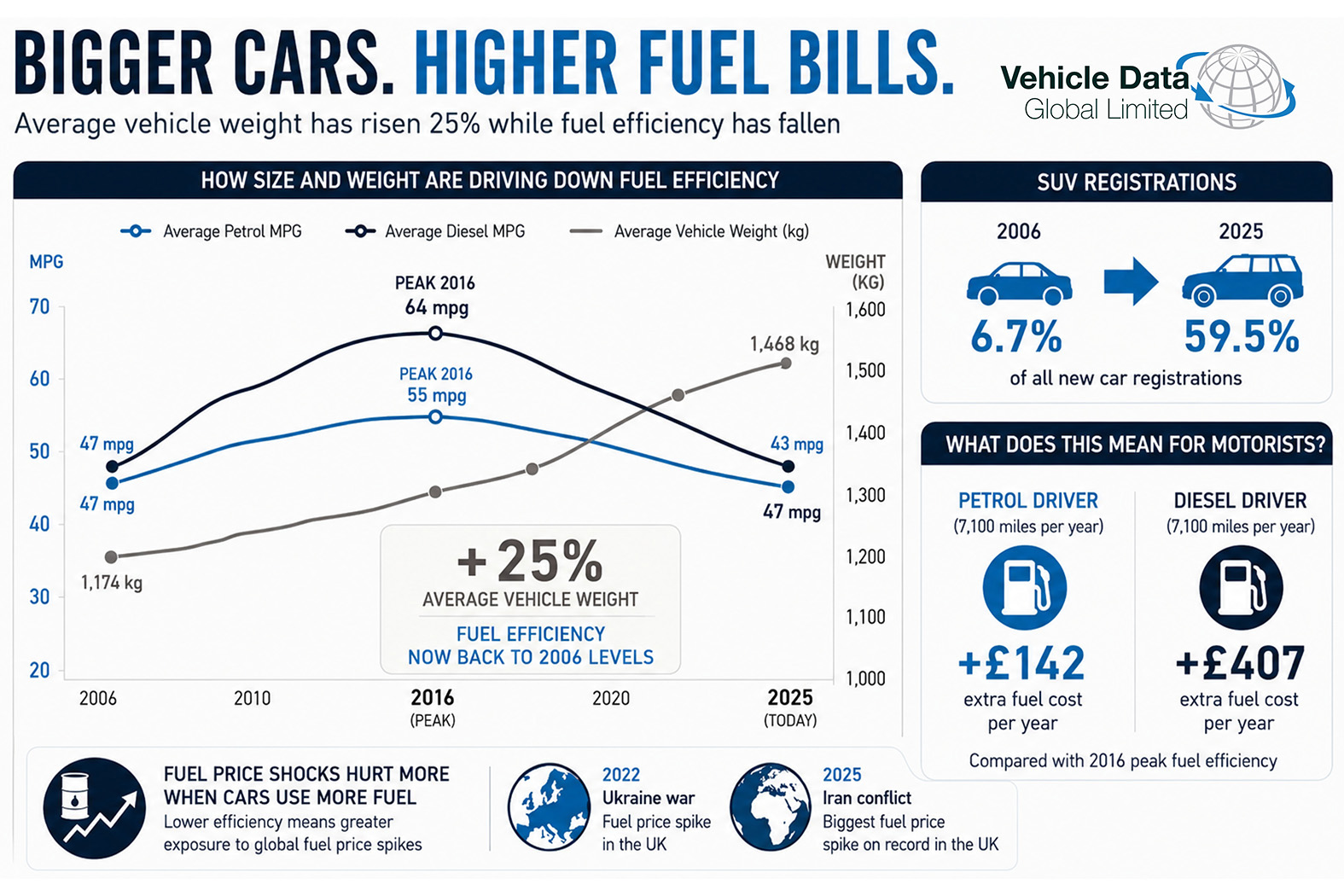
Data technology specialists Vehicle Data Global (VDG) report that average petrol car fuel efficiency peaked at 55 mpg in 2016, then fell back to 47 mpg today, caused by cars becoming bigger and heavier. Average petrol MPG is now roughly where it was in 2006.
The picture is worse for diesel car efficiency, which also peaked in 2016 at 64 mpg, but is now just over 43 mpg. This is even worse than 2006's 47 mpg.
A taste for SUV and crossover cars is largely to blame for the reduction in fuel economy. New SUV body-style registrations have climbed over 20 years from 6.7 per cent of the market to 59.5 per cent last year. And VDG has identified that this was accompanied by a 25 per cent increase in average car weight.
But despite increases in comfort and safety, two wars in four years have exposed motorists to major fuel price surges, as Britain saw the biggest fuel cost spike on record when the Iran conflict began.
VDG's analysis suggests that in financial terms the taste for bigger cars means a typical private driver covering the current average 7,100 miles pays £142 per year more for fuel and a diesel owner has to find £407 more than if cars had remained at 2016 peak fuel efficiency.
For major car fleets operating on a three-year and 60,000 mile cycle the additional average annual cost is £447 per petrol car and £1,188 for a diesel, attributable to reduced fuel efficiency. Across the entire cycle that's an additional £1,341 for petrol and £3,564 for diesel.
Van fleets on the same cycle now face total increased fuel expenditure of £7,180, with £2,888 of that caused by decreased fuel efficiency.
Diesel drivers have faced a double whammy over the same period due to a particularly stark decline in fuel efficiency.
Efficiency peaked for diesels in 2016, at an average 64 mpg, but has declined to below 44 mpg today, while diesel pump prices increased over the period by around 70 per cent.
VDG also notes that motorists switching to hybrids - the second most popular powertrain today - are unlikely to be benefiting as much as they hoped from greater claimed fuel efficiency.
This is because the published fuel efficiency of an average 186 mpg is typically achieved by testing in ideal world conditions. This maximises use of electric motor only, which is unlikely to be replicated by most drivers.
For Britain's van drivers - who still overwhelmingly favour diesel - the picture is similar, with vans also growing in size and fuel economy falling from 47 mpg in 2016 to 37 mpg now. So a typical private van driver covering 12,600 miles over a year is having to find an extra £1,508 to fill up - with £606 of that caused by the decline in fuel efficiency.
Ben Hermer, operations director of Vehicle Data Global, said: "Our analysis shows that spikes in fuel prices are only part of the story about increased costs for motorists.
"Increasing average car size and weight have taken a toll on fuel efficiency and exposed us all the more to sudden shocks to energy markets, such as the Ukraine and Iran conflicts.
"Our data highlights that the benefits of comfort, safety and prestige that an SUV-style car brings also comes at a significantly increased daily cost."